
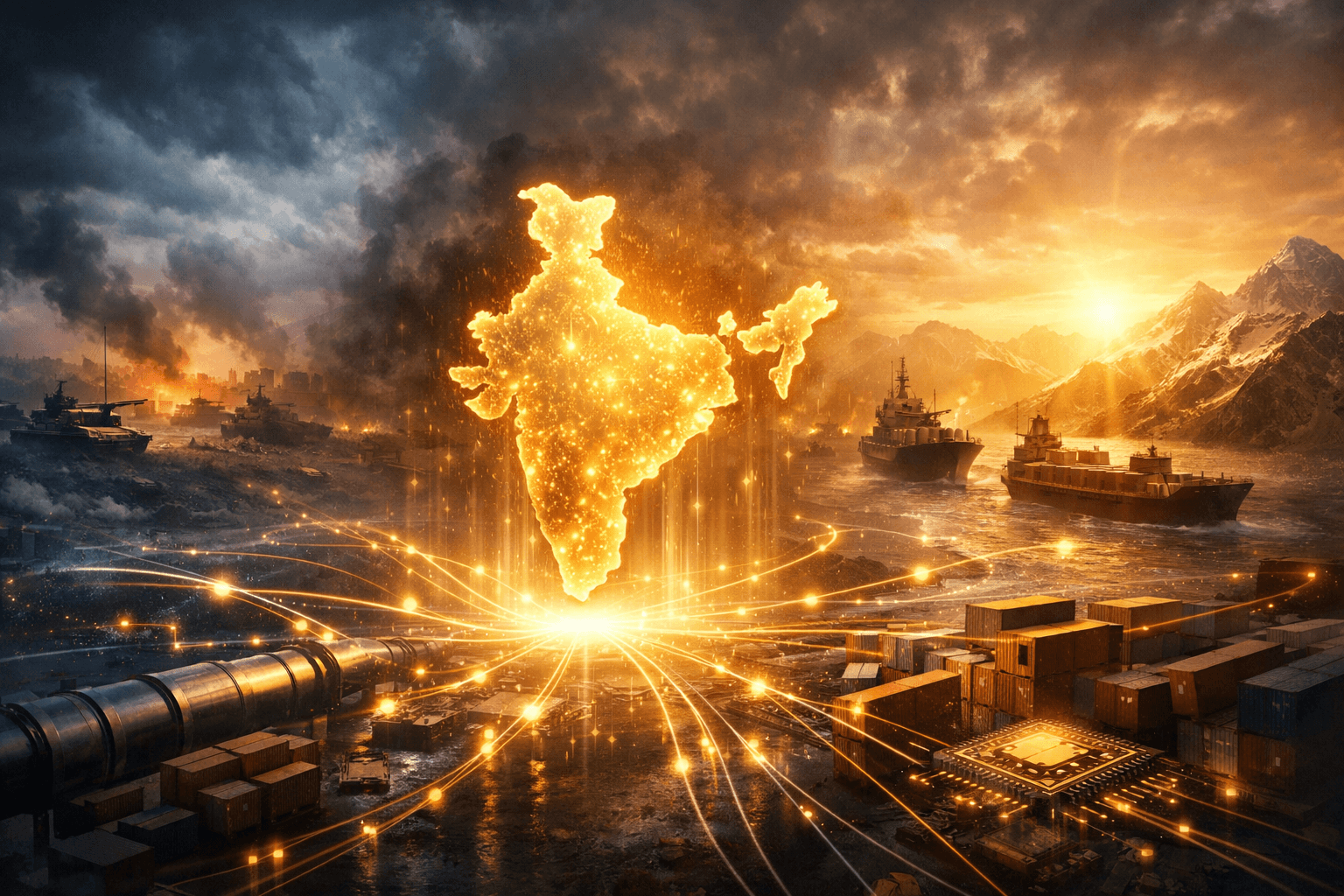
NAVIGATION IN A STORM: INDIA'S STRATEGIC PATH AMIDST GLOBAL POLYCRISIS
Vishal Kale
As of April 2026, the global geopolitical landscape resembles a shifting kaleidoscope rather than a stable map. The world is currently navigating a polycrisis—a simultaneous combustion of the prolonged Russia-Ukraine conflict and a volatile, high-stakes confrontation in West Asia. However, the current month has brought a series of unexpected diplomatic pivots and fragile truces that have placed India in a unique, albeit challenging, position of influence.
THE TACTICAL INTERMISSION: GLOBAL CEASEFIRES
The most significant shift this spring is the fragile ceasefire currently holding in West Asia. Mediated through complex back-channels involving global powers and regional stakeholders, this truce has momentarily silenced the missiles over critical trade routes.
For India, this cooling-off period is a vital economic lifeline. As a country that imports over 80 percent of its crude oil, the stabilization of Brent crude prices—which recently threatened to breach the 120 dollar mark—is essential for maintaining domestic fiscal health. While the underlying tensions remain, this intermission allows India to recalibrate its energy security and protect the common man from a new wave of imported inflation.
THE SILENT SHIFT: THE INDIA-CHINA RAPPROCHEMENT
While global attention remains fixed on West Asia, a monumental shift has occurred closer to home. Following months of quiet, high-level negotiations, India and China have reached a significant understanding to de-escalate their multi-year border standoff.
THE PATROLLING BREAKTHROUGH
In a major diplomatic breakthrough, both nations have implemented new patrolling arrangements along the Line of Actual Control (LAC). This includes a return to the status quo in sensitive areas such as the Depsang Plains and Demchok. This secret thaw suggests a pragmatic realization: in a world of global instability, a prolonged Himalayan conflict is an expensive distraction that neither Beijing nor New Delhi wishes to sustain.RESTORATION OF BORDER TRADE
Signalizing the depth of this de-escalation, the reopening of the Lipulekh Pass for border trade is scheduled for June 2026. This move, closed for six years, marks a shift from pure military posturing to a cautious resumption of economic ties, providing a much-needed boost to local Himalayan economies and reducing the immediate threat of a two-front war for the Indian military.
THE GEOPOLITICAL BALANCE SHEET: 2026 ANALYSIS
The current state of global affairs acts as both a headwind and a tailwind for the Indian economy.
WHERE THE DAMAGE LINGERS
Supply Chain Volatility: Despite the ceasefire, maritime insurance premiums remain high. Indian exporters in the textiles and engineering sectors continue to face squeezed margins due to high freight rates.
Fiscal Pressure: The Wait-and-See approach of global investors has kept the Indian Rupee under pressure, making technology imports and foreign debt servicing more expensive.
The Fertilizer Factor: Any disruption in global gas supplies impacts the cost of fertilizers, forcing the Indian government to increase subsidies to protect the agricultural sector, which stretches the national budget.
HOW INDIA IS BENEFITINGThe China Plus One Momentum: As Western nations accelerate their de-risking strategies, India has emerged as the premier destination for manufacturing. FDI inflows in electronics and semiconductors have reached historic highs in the 2025-26 cycle.
Strategic Autonomy: By maintaining ties with Russia for energy, the US for technology, and leading the Global South, India has successfully avoided becoming a vassal state to any one power.
Defense Indigenization: The global ammunition shortage caused by ongoing wars has fast-tracked Atmanirbhar Bharat. India is no longer just a buyer; it is now co-designing jet engines and high-endurance drones with global partners.
THE WAY AHEAD: NAVIGATING THE FOG
The road forward for India is not about picking a side, but about building a more resilient, self-reliant ecosystem.
First, Energy Sovereignty: The only way to win the Energy War is to decouple from oil. Indias push for Green Hydrogen and Solar power is now a national security mandate, intended to insulate the economy from Middle Eastern volatility.
Second, Institutionalizing Diplomacy: India must move the secret agreements with China toward a permanent no-war zone framework. Neutralizing the land-border threat allows India to redirect resources toward maritime security in the Indian Ocean.
Third, Digital Public Infrastructure (DPI): As physical trade routes become contested, Indias export of digital technologies like UPI provides soft power and economic influence that cannot be blocked by naval destroyers or mountain divisions.
FINAL PERSPECTIVE
India is currently the swing power of the 21st century. While the global war situation brings immediate pain to our pockets, it has also provided a historic window to establish India as an indispensable third pole in a multipolar world. The challenge will be to ensure that domestic growth remains inclusive enough to weather the global storms raging outside our borders.
Vishal Kale
+91 9494-60-0808

About Us
Blogs
Our Services
Careers at KASA
Disclaimer
Office Address
2nd Floor, Chunawala Chambers, Next to Pune Shikshan Mandal, 103, Shivajinagar, Pune - 411005.
Other Offices
Delhi | Mumbai | Chhatrapati Sambhaji Nagar | Ahilyanagar | Nashik